

Introduction
The term drafting means preparing the primary form of a document. When we talk about drafting a legal document. Basic principles and rules are required to draft a meaningful document. In the legal field, we can say that drafting is a skill gained through hard practice. Anyone can achieve the goal of accurate legal documents by practising writing. No matter how you achieve that goal of writing. You can write a legal document either by handwriting or by using a digital method. Like, through a computer or other electronic games. But the motive behind the writing is to achieve the goal of drafting an accurate, perfect, and meaningful legal document. Therefore, you have to follow general principles of drafting. There are many things included in drafting a legal document. Like contracts, agreements, pleadings, legal notices, and much more. To write that kind of legal document, you have to know lots of things and legal knowledge is required to draft a well-structured legal document. In this article, we address the general principles of drafting. The rules you need to follow to make perfect and meaningful legal documents. The various steps involved in drafting, etc. So, please stay tuned and read below:
What is a draft?
Before we discuss in-depth the general principles of drafting, we first have to know what a draft is. The term draft cannot be described in a single meaning, it can vary depending upon where to use. It can be used as a form of text or drawing. But the general meaning of a draft, we can explain in the legal framework of a document. A draft is a preliminary version of a legal document. After making changes or modifications, the final legal document will be prepared. We can refer to a draft as a primary step in creating a document, which is to set the outline and structure of the main document. Writing documents, designs, drawings, charts, plans, letters, and pleadings are the best examples of drafts.
There are lots of benefits to preparing a draft; through this, the writer can put their ideal thoughts on paper and build a relevant structure. It also helps the author set up the structure of a document and identify the specific parts that need to be improved or changed. By creating a draft format, the author can get expert feedback from the proofreader, scholar, and other authors.
Writing a draft is a challenging task; there are some challenges connected to that. It becomes a problem when a writer feels overwhelmed by the topic. Stay focused and concise are very important while preparing a structured draft, if the author laps this thing he may fail to write an effective draft. Drafting work is time-consuming, so it is not easy to set a timeline for when to complete and make a final.
However, despite of challenges, writing a draft of a legal document is a significant part of making a meaningful structure. Thus, a drafting process is biased toward building a well-written final document. Through the drafting process, a writer can easily rectify errors and improve the quality of writing; as a result, they can deliver expert-level work.
What is drafting?
Drafting is creating a basic constitution of written documents. Preparing a legal draft includes various provisions of law, definitions, facts, and other legal terms to draft a legal document in legal language. The term legal drafting refers to creating a legal document; it includes different types of contracts, agreements, legal notices, pleadings, letters, etc. Legal drafting is a complex task; it needs more effort, hard work, and continued writing practice. Therefore, to understand the drafting process, you have to know several steps, which are given below:
Steps involved in the drafting process:
There are some basic steps involved in drafting a document that are given below:
Prepare a first draft and mention everything in detail that you need to do. Outlining all those things and specifying them in a single topic is essential for making a legal document as a final draft.
After preparing the first draft, you are required to add or remove some unnecessary details. This is a first draft that was made by you, in terms of reaching the final draft.
After making the necessary edits, it’s time to complete the goal of writing a final draft. In this term, you are required to recheck every section, such as drafting language, legal terms, subject details, etc. This makes the drafting more understandable for the intended audience and ensures all requirements are met for an individual or a company.
The general principles of drafting
The drafting process is important in every field, whether you want to prepare general, technical, or legal documents. But before making a final draft, there are lots of things required to achieve the goal of perfect and meaningful drafting. It involves some of the general principles and rules that are given below:
Essential rules of drafting a document
There are some rules for drafting a document that are given below:
-
The structure of the draft must be clear before drafting.
-
Any facts should not be admitted or denied without getting proof of it.
-
The legal terms must be used in the proper place in the document. Avoid incorrect or irrelevant information in the legal draft. That should result in a misguiding or misleading document.
-
Try to avoid negative sentences in a draft.
-
The draft language should use technical terms and be readily, clearly, and easy to understand.
-
A prepared draft should be defined topically and in paragraphs.
-
Before giving a final touch, the draft should be checked and verified.
General principles of drafting
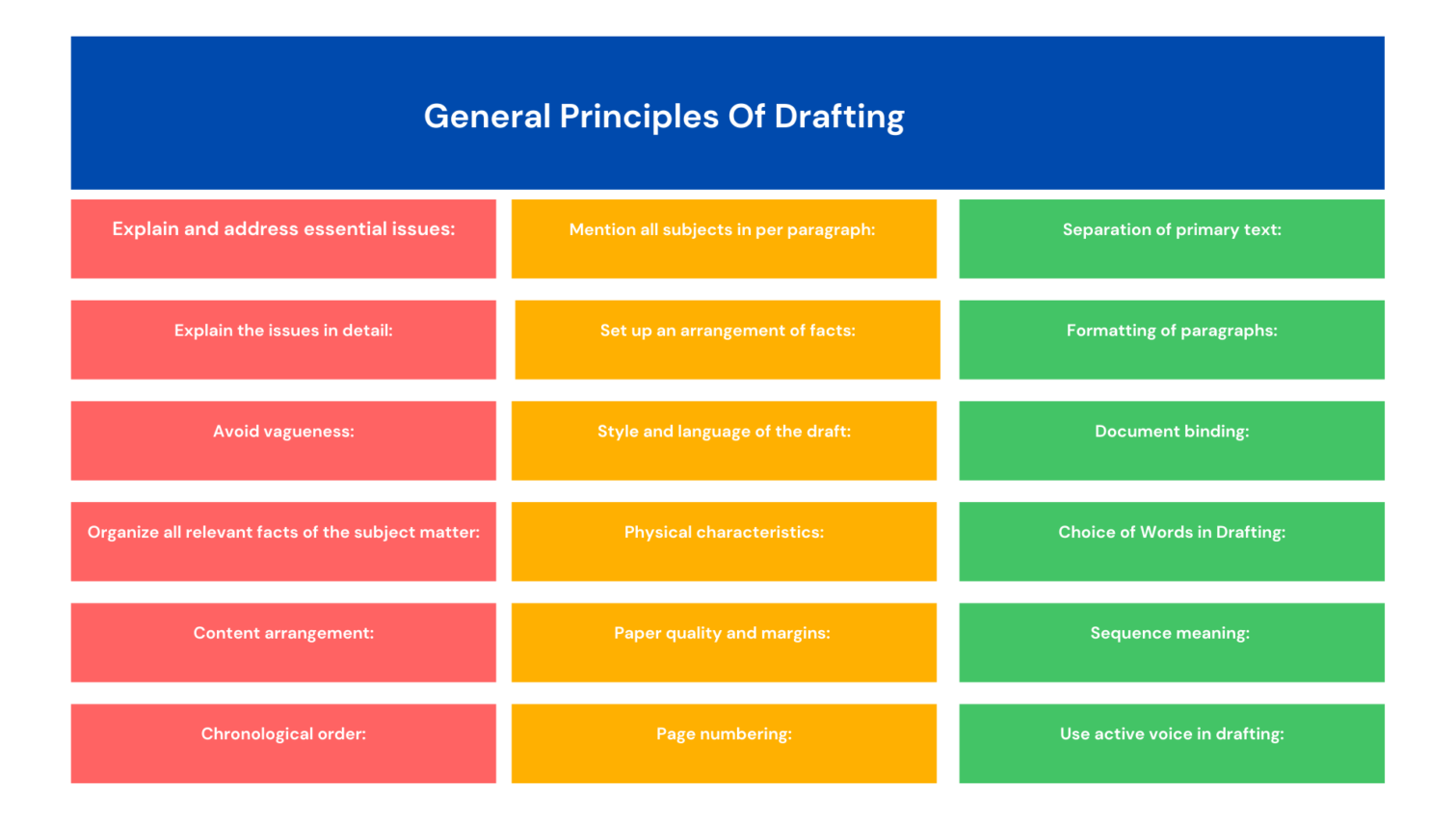
Explain and address essential issues:
The golden rule of the general principle of drafting is to include all essential topics. Some of the key issues are listed below:
Explain the issues in detail:
It is a fundamental principle of the drafting process. You need to include all the aspects of the subject matter without leaving out any point related to the purpose. To make an effective draft, you should include all important and relevant subjects.
Avoid vagueness:
Make the draft simple and easy language, so anyone who is not relevant can also understand what exactly the draft wants to say. This is why you should avoid some complex language.
Organise all relevant facts of the subject matter:
While preparing a legal document, arranging relevant facts of the subject matter is essential. It should be described in sequence, such as facts, information, and other details related to the draft. It reflects how the original draft is being formed. The draft idea must be set up consistently so the writing structure can be arranged as an expert draft.
Content arrangement:
The content of the draft should be arranged in an ideal flow. You should arrange all paragraphs and sections to focus on the main aspects of the draft.
Chronological order:
The content of the draft, such as relevant facts, arguments, information, and other topics, should be arranged sequentially. Try to draft in a chronological manner.
Mention all subjects in each paragraph:
The basic principle of drafting is describing all relevant subjects in separate paragraphs. It helps the reader to make clear distinctions between different subjects and easy to understand the main subject.
Set up an arrangement of facts:
While preparing a legal document, arranging relevant facts of the subject matter is essential. It should be described in sequence, such as facts, information, and other details related to the draft. It reflects how the original draft is being formed. The draft idea must be set up consistently so the writing structure can be arranged as an expert draft.
Style and language of the draft:
The writing style of a draft format is an essential part. It should be used simply and clearly. While you prepare a draft of a legal document, it is necessary to add legal terms according to the facts and subject matter of the draft. This why it should not be included complex and jargon, also not be fall in grammatical or spelling errors.
Physical characteristics:
It is advisable to have a drafted document in the standard quality paper size with proper alignment. It should be marked with numbering of each paragraph and page. The drafted document should be arranged with appropriate spacing.
Paper quality and margins:
To maintain a professional approach you should need to set a proper paper quality and margins. You may set the quality using 20 by 30 cm paper; arrange the top and bottom margins to be 4 cm, and the left and right side margins to be 2.5 cm.
Page numbering:
It should be marked with numbering of each paragraph and page.
Separation of primary text:
The basic principle of drafting is that you need to make a differentiation between primary and main text in the document. Such as, the table of contents and acknowledgements can be arranged in numbering using Roman numbers (I, II, III). The other part of the document should be described in Arabic numbers like 1, 2, 3.
Formatting of paragraphs:
Paragraph formatting gives a more professional look to a document. You should set the main document body part in double spacing; it gives clear readability to the reader. Make enough space between each paragraph and references.
Document binding:
Giving a good and fully professional look to a draft document, all papers, sheets, and attached acknowledgements bound together.
Choice of Words in Drafting:
The choice of words in the drafting of the document should be simple. It gives a more professional and significant quality. Some of the key points are listed below:
Sequence meaning:
The document words should be used in sequence in a draft copy. Each word has its sense and meaning, that’s why, try to use simple words. Avoid using complex and heavy words, as it may create confusion for the reader.
Use active voice in drafting:
Using active voice gives more clarity in conveying the path of the subject of a draft document. The passive voice also gives clarity in particular terms. However, if possible, prefer to use an active voice.
Difference between drafting and editing
When the first version of the legal document is made by you, it is called a draft. It is not complete, and you are required to add or remove some things to make it a perfect document. Thus, drafting and writing are treated as the same thing. Because you are required to follow the same process of drafting and editing. However, they are not the same; there are some differences between them. Let’s discuss below:
When you complete the first version of a draft, you are involved in redrafting it. It means you are going to prepare a second or third draft, or more if you feel it is necessary.
Editing will start after the completion of the redrafting process. In this process, you need to fix some errors and polish your draft to the point of expert drafting. Editing is a complex process compared to drafting. It consumes more time and attention, but it becomes easier when you are involved and get into the flow of the work.
Conclusion
Creating a legal draft is not an easy task that needs more practice, research, knowledge, and hard work. But after all those things, the draftsman must follow the general principles of drafting. It provides a proper strategy for preparing a legal document systematically, meaningfully, lawfully, understandably, and acceptably for the client’s legal purpose.
Also Read: Know Every Fact And Procedure For Filing a Review Under CPC
When do you need to file a legal notice for recovery of money?
How To Send Legal Notice Before Taking Legal Action